Thursday, March 26, 2009
Blog #6
Ethnographic films and photography are seemingly intertwined because they served the same purpose; to try to explore/expose different cultures and the way they lived. The ethnographic films were biased since their perspective was from white filmmakers and because of this native americans were viewed as subjects. Photos were used as a form of propaganda, native americans were seen with certain costume-like attire such as feathers, costumes, buffalo hides) and the lighting was often dark and shadowy subliminally communicating a savage like identity, these photos and films were seen by people who hadn't any weren't likely to connect with native americans which created a form of prejudice against them and allowed a genocide-like interaction to be accepted. The pictures of the women were indeed pornographic, the pictures possess a strong sense of masculinity due to the pose, the dark overcast in the photos and the strong, angular poses of their bodies. These photos reinforces the idea of the native american as a savage. Native American women were often viewed as too masculine, rather than courageous and strong and that is clear in the photos, yet the exposure of their breasts seems to be a form of mockery, as if exposing them in such a manner would obliterate any sort of fear/uneasiness most europeans had with the native american women's strength.

Friday, March 13, 2009

I am interested in working on an archival history of Johnson's Park. I am very excited to research this neighborhood and see what it looked like before and how it has evolved over time. I am interested in hearing the stories of the Elders and also capturing the youth. I want to create a document that gives an overall historical, cultural snapshot of this neighborhood. I also want to allow my research through newspaper articles, old photos, etc. to speak my own interpretation of this neighborhood, and its energy.
Friday, March 6, 2009
Blog 4
It is clear that the difference between Vin Diesel and Senna is based on their own individual experiences. For example, Vin Diesel did not gain acceptance from either worlds (Italian or African American) which was obvious in his short film multi-facial. In his experience, he was viewed as undefinable, casting calls either said he wasn't black enough/urban enough or italian enough. This forced him to embrace his undefinable-ness. He wanted to be recognized for his talent alone, opposed to being categorized by race. It seems as if Vin Diesel embraces this new idea of racelessness, which is ultimately where America is headed. Senna seems to feel more accepted in the African american community, it is true that African American communities have a stronger likelihood of accepting biracial heritage, opposed to white society. I think this is the very reason why she identifies as black, simply because of the welcoming acceptance and because of her strong pride in the culture. The standards of beauty within american films definitely adhere to European-american standards still, which means that despite the range of cultures onscreen, they all still represent those standards. For example, the film The fast and the Furious had primarily asian and latin american women cast, but they were all tall and thin, with symmetrical facial structures and no "exotic features". This is a European standard of beauty and doesn't represent all women of color or the beauty standards within their own culture. Another example is also taken from the Fast and the Furious. Vin Diesel was paired with Paul Walker(anglo-american actor) and they were viewed as a heroic team. The hero/leader of the film was Vin Diesel but he was paired with a white co-actor, whose role wasn't necessarily needed but makes the audience feel more comfortable with an undefinable main character because of his co-partner being white. This is also evident in Eddie Murphy's film Beverly Hills Cop II.
Friday, February 27, 2009
Erica Woods
Film 150: Multicultural America
Media Literacy Exercise
February 27, 2009
Operation Assimilation; The American Way!
There are two photos in particular that struck me as correlative towards one another in very interesting ways. They are titled:” Refrigerator” by Osa and Martin Johnson, 1920 and “Receiving Dolls” taken by Toyo Miyatake, 1943.
These two photos capture a brief encounter of the assimilation into American Culture that all people of color have experienced throughout American History.
“Refrigerator”
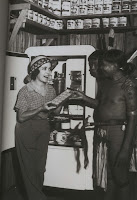
This picture is very narrow and it seems to provoke the viewer to only focus on the woman in the picture, despite the fact that there are two others in the photo. There is shadow overcast on the two Native Americans and the lighting is centered on the refrigerator and the woman, who is holding an ice tray. Her smile is bright and captured fully, while it seems as if the Native Americans are also smiling, yet the photo was shot only getting a side angle of their smile, instead of a direct pose. It is evident that they are in a kitchen, due to the images of cans sitting above the refrigerator. This photo was taken in 1920, which was during the time where Native Americans were living in poverty, suffering from various diseases and facing devastation due to the fact that they were being forced to migrate onto small reservations after the European settlers came over and took over the land. Neglected by the government, Native Americans had little to no resources such as food, shelter, etc. Concerned American citizens began to realize that the only way to help the Native Americans was to teach them to adopt certain customs, methods of survival of the American people (assimilation) which included using he refrigerator in order to preserve food, instead of the daily hunting that the Native Americans were accustomed to prior to the arrival of the European settlers. This photo was captured in order to illustrate the progress of the Native Americans into the American culture, which manipulates the viewer into thinking that there was a mutual acceptance and willingness to assimilate from the Native Americans, which history proves was not entirely the case.
The second photo “Receiving Dolls” was taken in 1943.
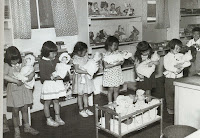
The frame of this photo is a bit wider, the viewer can catch an overall glimpse of the surroundings, and it seems like a nursery. The lighting is very bright, indicating a happy setting, particularly because all of the young girls appear to be smiling. It also very interesting that the girls are standing in a somewhat straight line, which curves in a slight circular motion towards the far right-hand side. This location of this photo is actually an internment camp. Taken in 1943, just a year after the United States forced all Japanese Americans to relocate from their homes due to the war, which created a somewhat uneasy relationship between Japanese aliens and the U.S. Government, which led to the migration of over 100,000 Japanese Americans who lived in states bordering the Pacific Ocean. This photo was taken by the American Friends society, which is an organization of American citizens who step in and help civilian war victims. This organization donated the dolls to the Japanese American girls and represents a re-assimilation process, a year after the Japanese Americans were banned from their homes and placed in these internment camps, they were then still taught to assimilate into the American culture in these structured environments and totally reliant on the U.S. government for housing, Medicare, food, etc.
In conclusion, it is evident that Native and Japanese Americans had to assimilate into the American culture, in order to survive, literally. It was also interesting that in both photos, though taken roughly twenty years a part, both minorities were receiving “gifts”. What does it actually mean to assimilate into “American” culture, how can it be defined? “White patriarchal capitalism, ideas about race and ethnicity are constructed and circulated in ways that tend to keep white privilege and power in place”(Benshoff and Griffin, 51). Giving these dolls to the Japanese girls and the refrigerators to Native Americans, communicates that this is the cultural “norm” and diminishes the basic survival skills that ethnic groups had been using for centuries. It is sort of a way to phase out cultural customs and align under one ideology as people, at the same time assimilation into white culture is viewed as the normal, human experience, a form of cultural invisibility as explained by Benshoff and Griffin, “The White power base maintains its dominant position precisely by being consistently overlooked…unexamined in most mainstream texts”(Benshoff and Griffen, 53). Until America begins to question whiteness as a culture and not an ideology, we are all conforming to some form of assimilation, how can America pride itself on rich culture and diversity with such a monotonous cultural voice? Films help us examine multicultural stereotypes/misconceptions and in time will hopefully celebrate our true, multicultural American people.
Works Cited
2. Marita Sturken & Lisa Cartwright, “Viewers Make Meaning,” Practices of looking: an Introduction to Visual Culture. 2nd ed (New York City: Oxford University Press, Inc, 2001) 49-59.
3. Memorial Hall Museum Online American Centuries...view from New England. 23February2009. Pocumtuck ValleyMemorialAssociation. <http://www.memorialhall.mass.edu/turns/view.jsp?itemid=13161&subthemeid=18>
4. The virtual museum of the city of San Francisco. 22February2009.
< http://www.sfmuseum.org/hist10/relocbook.html>
Pg 45.
Thursday, February 26, 2009
After slavery was abolished in 1865, African Americans wanted to expand their horizons and look for other jobs opportunities, which eventually led to the "Great Migration" in Northern cities such as; Chicago, Harlem, Detroit, etc. These job opportunities were granted to African Americans primarily because of contract disputes with European Immigrant workers, and the desperate need for cheap labor.
The production code was implemented in a hopeful attempt to abolish negative stereotypes of African American roles in film however, the roles of African Americans on film were still subservient but were not as blatant as before. The roles of African American actors became domesticated, for example Dorothy Dandridge played the role of a "jungle goddess" the "tragic mulatto" for which she received an Oscar, we can see similar instances of the same stereotypes today, such as Halle Berry's role in Monster's Ball (sinful miscegenation)for which she also won an Oscar. It almost seems as if this production code was put in place to quiet down the protests about the negative stereotypes of African Americans, and yet films still create the same characters, subliminally.
It is also evident that Blaxploitation films were a result of the production code, because of the attempt to expand on the identity of African Americans outside of the mammie, coon, etc. During the late 60s and 70s African Americans were becoming more aggressive with their approach towards equality, movements such as the Black Panthers emerged during this time frame.These films made poor attempts to "capture the black experience" produced by white filmmakers the actors portrayed pimps, hoodlums, and drug dealers, which ultimately provoked the African American youth to imitate these roles, given that they appeared to be glamorous/admirable.
Spike Lee became a success because his films showed African Americans as they are; human. His films are about the struggles of the African American people such as racism, double-consciousness, and their dreams, which are just like every other American, to have an education, raise a family, experience happiness, pain, etc. It is still a struggle today for Spike Lee to find funding for his films and as a result he does have to conform to the societal demands of Hollywood productions. For example, he made the film Inside Man, a more socially accepted film with a diverse cast, in order to get funding for the film Miracle at St. Ana which told the story of African American soldiers in World War II after having a dispute with Clint Eastwood because of the lack of African American soldiers represented in his film "Letters from Iwa Jima" which also told the story of WWII. Spike Lee's films are definitely telling the stories of African Americans, unbiasedly and overall, I believe Spike Lee is an incredible filmmaker, it is sad though that even in today's era he along with other people of color still have to conform to a "cultural norm" in order to be broadly accepted among all American people.
Thursday, February 19, 2009
Othering can be defined as; The process of defining one group against another. It is a defense mechanism that one group of people use to identify an unlikeable trait that they see within onto another group and apply negative judgment towards them because of it. Hollywood has a tendency to include "token" ethnic characters in mainstream films in order to prevent racial tension between themselves and their audience. If Hollywood films choose to include "ethnic characters" their roles are often "cliche" and "stereotypes" usually with negative, subliminal connotations.
Initially Irish Americans did succumb to these stereotypical roles as well, such as the drunken, fiery-tempered working class. However, once the Irish chose to assimilate into the American culture their roles began to change, becoming more a part of the cultural "norm" and widely accepted as "white/standard". The black face was used by Jews to illustrate the extreme differences between themselves and the Irish in opposition with African Americans. Since white Americans viewed all of these groups as subordinate, it seemed as if the Jews and Irish americans used the black face in order to gain more acceptance at the attempt to assimilate into the white culture. On the other hand, the fact that this act was combined with Yiddish it also seems as if these acts were magnifying the confusing parody of racial categorizations defined by white culture.
I think it is important to study race and racial images simply because it is such a huge factor in our culture. America is obsessed with categorizing and labeling people and it is impossible to be oblivious to that. Perhaps it is also a flaw, and understanding and depicting racial images can help us understand what happens in our minds and how these prejudices manifest. Whites are often viewed as the "norm" or just plain human beings, the are judged based on the content of their character opposed to the color of their skin and all of the negative connotations associated with that particular skin color. Examining whiteness is going to be misinterpreted as reverse racism, white people are going to assume the role of the victim and by examining their role even more, will not change the glorifying of their whiteness even more. The paradox remains the same; whites are seen as human beings and our sub-consciously used as a form of ideology; what everyone should try to measure up to.
Sunday, February 15, 2009
Blog #1
I am really excited to be doing service learning at the Johnsons' Park Neighborhood association. I was particularly in awe of the fact that Joseph Zilber donated 50 million of his own money to revitalize this community, I am excited about the fact that they have Alice's garden because it is very rare for urban environments to have affordable produce in their neighborhood. I also thought it was interesting that the money donated was used to build better homes in the area and also to renovate older homes of the lifetime residents as opposed to tearing those down and rebuilding the whole neighborhood, that shows me that the neighborhood is interested in preserving their community while also strengthening it with more resources. I love the fact that the residents determine what is needed and that they have created an organized environment, I am also glad to see that the crime rate has been lowered and I am glad that this is one of the first steps that the City is taking in order to revitalize within instead of from the outside in. I know it will be that much more successful from this approach.
Subscribe to:
Posts (Atom)